Grounded AI · U.S. public data

The answers are already
in public data.
We make them findable.

Lynxsen builds AI tools that turn United States federal open data into answers people can act on — for clinicians, for patients and caregivers, and for the people who decide budgets. Every figure our tools state comes back from a real public dataset, named on screen. Nothing is invented.

Sentinel advances to Phase 2 of the TOPx HHS Tech Sprint

Selected in the Lyme Innovation area for its use of artificial intelligence, U.S. open data, and real-world evidence.

3tools live today
6federal agencies as sources
100%of figures traced to a source
FHIR+ MCP, so others can build on it
The approach

Public data everyone can download.
Answers almost nobody can reach.

The United States publishes an enormous amount of health and economic data. It is free, and it is largely unusable in the moment someone needs it — spread across agencies, in different shapes, and never assembled into the one answer a person is actually looking for. Lynxsen closes that last mile.

Assemble

We bring scattered federal sources into one common shape, so a question that spans four agencies can be answered as a single number or a single read.

Ground

Our assistants must look a figure up before they can say it. Every number on screen names the public dataset it came from, so it can be checked rather than believed.

Hand off

Results leave in standard health-data formats, and the same grounded lookups can be called by other people's AI tools — so the work is reusable, not locked in one app.

What we've built

Three tools. One engine.

The same grounded-data engine serves three very different people facing the same problem — something important that stays invisible for far too long.

For clinicians

Sentinel

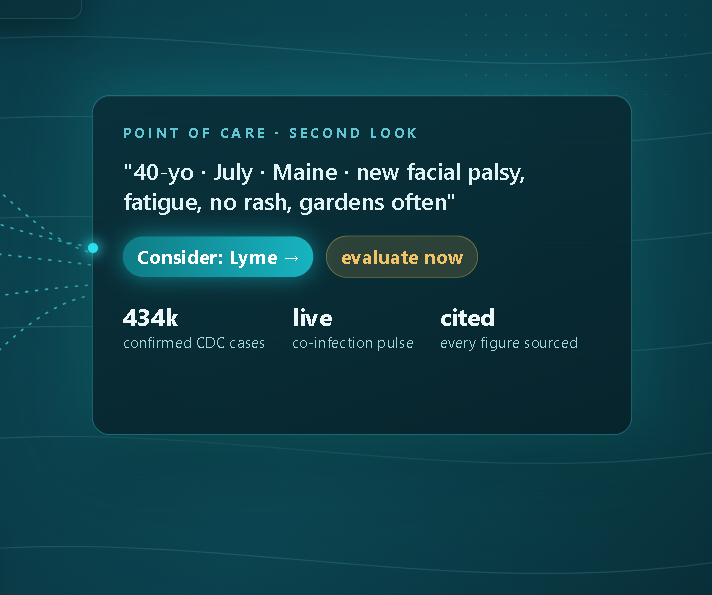
Point-of-care decision support · tickborne disease

Lyme disease is very treatable when it is caught early, and it is missed often — outside the classic regions, off-season, or without the textbook rash. A clinician describes a case in plain language and Sentinel returns a local, cited read: what to consider, weighted by real incidence for that state and season.

  • Symptom pattern drawn from confirmed CDC case data
  • Live co-infection surveillance and county-level counts
  • Says "consider," never "diagnose" — guideline-anchored
Try Sentinel →
Sentinel — point-of-care second look
For patients & caregivers

Compass

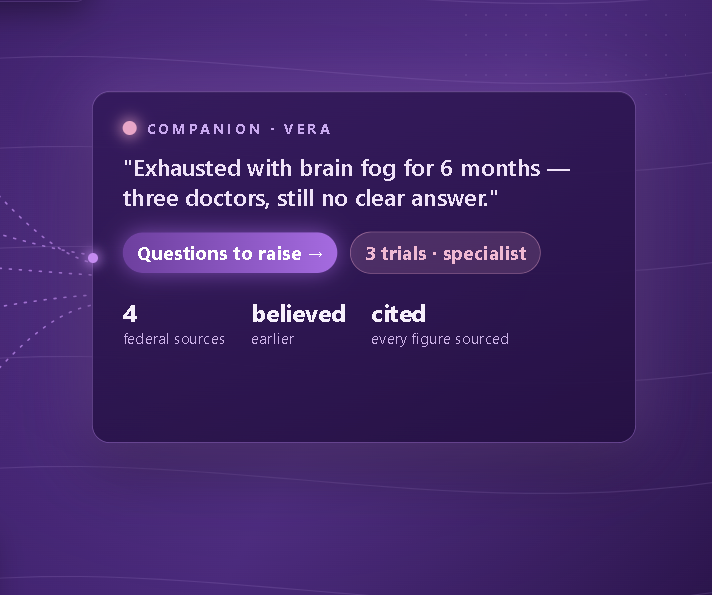
A companion for invisible illness

Many people spend months or years with vague, tiring symptoms before anyone names the problem. Compass's companion, Vera, reads what someone is going through and offers practical, grounded help — treating people as capable, not fragile.

  • Questions and tests worth raising at the next visit
  • Real clinical trials and specialists from federal data
  • A caregiver plan, and a summary to share with a care team
Try Compass →
Compass — a companion for invisible illness
For policy & public health

Burden Atlas

The local cost of diagnostic delay

When a cost cannot be seen, it is easy to under-fund. Burden Atlas turns scattered federal data into one local number — the annual cost of diagnostic delay for an invisible illness — down to the grain where budgets are actually decided.

  • Fuses claims, out-of-pocket, wage and prevalence data
  • Shows what is measured versus modeled, assumption by assumption
  • Estimates what shortening the delay would return
Try Burden Atlas →
Burden Atlas — the local cost of diagnostic delay
Grounding

A number you can check
beats a number you're asked to trust.

Confident-sounding software that quietly invents figures is worse than no software at all — especially in health. So we designed against it from the start.

Every figure is a lookup

Our assistants cannot state a number from memory. They have to call a real dataset and report what comes back — with the source named on screen.

Silence beats a guess

When a public source is unavailable, the tool says so plainly and returns nothing for that figure. It never fills the gap with something plausible.

Checked by a second model

An independent review scores each answer on whether every claim traces back to the public source it cites — a check that runs separately from the assistant that wrote it.

Measured or modeled, always labeled

Where a figure is estimated rather than measured, we say so and show the assumption — so it can be argued with, adjusted, or rejected.

About

Built by someone who ships.

Lynxsen is the work of a builder with more than 20 years across government, big technology, and non-profits, focused on shipping production AI, data, and cloud applications.

A consistent theme in that work has been closing the gap between what is technically possible and what organizations actually run — particularly in public-sector and health settings. Earlier work includes building data centers for hospitals, leading healthcare technology modernization, and advising healthcare technology providers on cloud-native AI.

Lynxsen exists because the most useful health data in the country is already public, already free, and still almost impossible to use at the moment someone needs it.

Amer Doko Founder, Lynxsen

Working on something in this space?

If you work in public health, care delivery, or policy and any of this is useful to you, I'd like to hear about it.